Why Do Parents Worry More About Their Daughters Than Their Sons?
There is a curious di erence in the way many parents worry about their children. They may worry about both sons and daughters, but when a daughter reaches adolescence, parental anxiety often seems to increase. Her movements are watched more closely. Her friendships are questioned more carefully. Coming home late becomes a bigger issue. A new relationship can create considerable concern.
Why?
The simple answer is not that daughters are more troublesome than sons. Rather, parents often perceive the world as more dangerous for girls—and society has taught them to do so.
From an early age, girls are often told to be careful. Be careful where you go. Be careful who you talk to. Be careful what you wear. Be careful when you come home. Be careful with boys. The warnings are usually well-intentioned, but they reveal something important: parents believe that girls face consequences from which they may not be able to protect them.
Safety is perhaps the greatest concern. Parents know that girls can face harassment, exploitation, unwanted attention, and sexual violence. As daughters become teenagers and gradually gain independence, parents realise that they cannot be beside them every minute. That loss of control can produce anxiety.
Then comes reputation.
In many societies, boys and girls are still judged by di erent standards. A boy who stays out late may be described as adventurous or independent. A girl who does the same thing may immediately become the subject of parental concern. A boy’s mistake may be regarded as a temporary mistake; a girl’s mistake may be treated as something that could a ect her reputation, relationships, education, or future.
This double standard creates another problem: parents sometimes confuse protection with control.
A daughter may hear:
“Don’t go there.”
“Don’t talk to him.”
“Don’t come home late.”
“Don’t trust people.”
The intention may be love, but excessive restriction does not necessarily produce wisdom. Eventually, the daughter has to enter the world without her parents standing beside her.
Therefore, the real question should not be, “How can we keep our daughters away from danger?”
It should be:
“How can we prepare our daughters to recognise danger and respond intelligently?”
This is where education becomes more important than supervision.
Girls need to learn how to establish boundaries, recognise manipulation, make independent decisions, manage relationships, seek help, and take responsibility for their choices. They need con dence—not simply protection.
Interestingly, parents sometimes make the opposite mistake with sons. They give boys more freedom because they assume boys can take care of themselves. Yet boys also face danger. They can be manipulated, exploited, bullied, pressured into risky behaviour, involved in unhealthy relationships, or struggle silently with emotional problems.
The di erence is often not the amount of danger.
It is the amount of attention parents give to that danger.
There is also an emotional dimension. Daughters may sometimes communicate their feelings and di culties more openly with their parents. Parents therefore become aware of problems that might remain hidden in their sons. A quiet son may appear perfectly ne when he is actually struggling.
Ultimately, raising daughters requires a gradual transformation.
Protection must become preparation.
Supervision must become guidance.
Rules must become judgement.
Dependence must become competence.
Parents cannot remove every danger from their daughters’ lives. Nor should they try to.
Their responsibility is to give their daughters the knowledge, con dence, values, and judgement necessary to navigate those dangers.
A daughter should eventually be able to walk into the world without her parents constantly asking, “Where are you? Who are you with? What are you doing?”
Instead, she should carry something far more valuable with her:
“I know how to look after myself. I know how to make good decisions. And if something goes wrong, I know when and how to ask for help.”
That is the point at which parental worry begins to turn into parental trust.
And perhaps that is one of the greatest achievements of parenting—not raising a child who never encounters danger, but raising a young person who is capable of facing the world wisely.
The Two Extremes of Teaching
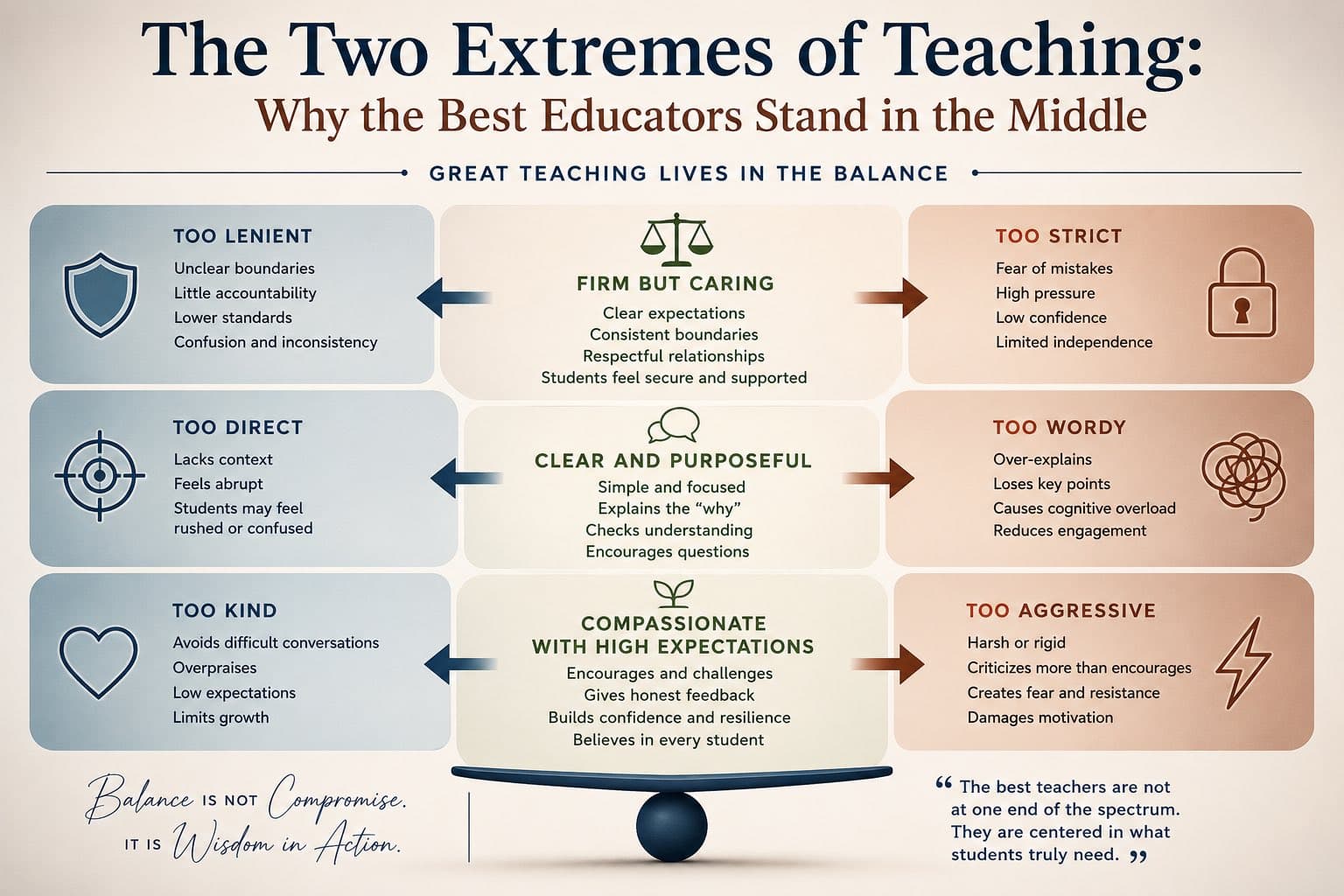
The Two Extremes of Teaching: Why the Best Educators Stand in the Middle
“Education is not about choosing between kindness and discipline. It is about knowing when each is needed.”
Teaching has always been a profession of balance. Every classroom is filled with unique personalities, different learning styles, varying emotional needs, and diverse family backgrounds. Because of this complexity, no single teaching style can meet the needs of every child in every situation.
Yet many educators unintentionally drift toward one of two extremes. Some become excessively permissive, believing that students learn best when they are completely free. Others become excessively strict, convinced that discipline alone produces excellence. Some teachers communicate with blunt efficiency, while others explain endlessly until the original point disappears. Likewise, some educators become so gentle that expectations lose meaning, whereas others become so rigid that learning becomes associated with fear.
Psychology consistently reminds us that human development flourishes neither in chaos nor in oppression, but in environments where warmth and structure coexist. The most effective teachers are not those who remain fixed at one end of the spectrum; they are those who understand when to move along it according to students’ developmental needs.
1. Too Lenient vs. Too Strict
Perhaps the oldest debate in education concerns discipline. A too lenient teacher rarely enforces rules. Deadlines become suggestions. Poor behaviour receives little consequence. Students are repeatedly given “one more chance.”
Such teachers usually possess admirable intentions. They genuinely care for children and wish to avoid conflict. Many fear damaging relationships with students or being viewed as authoritarian. Psychologically, this approach often stems from high empathy combined with conflict avoidance. Some educators may have experienced harsh schooling themselves and consciously reject that model.
Initially, students often enjoy such classrooms. The atmosphere appears relaxed and friendly. However, over time, problems emerge.
Without clear boundaries:
• classroom routines become inconsistent;
• motivated students become frustrated by disruptions;
• self-discipline fails to develop;
• expectations become unclear;
• academic standards gradually decline.
Ironically, children frequently feel less secure rather than more secure. Developmental psychology shows that predictable boundaries create psychological safety. Young people test limits not because they dislike rules but because they seek certainty.
The opposite extreme is the too strict teacher. Rules dominate every lesson. Minor mistakes receive immediate correction. Silence becomes more important than curiosity.
These teachers often believe that high standards produce high achievement. Many were themselves successful under strict educational systems and assume similar methods benefit everyone. Indeed, strict classrooms may initially appear highly effective. Students sit quietly. Homework is submitted punctually. Test scores may even improve in the short term.
However, excessive rigidity often carries hidden psychological costs.
Students may:
• participate less;
• fear making mistakes;
• avoid asking questions;
• become dependent on constant external control;
• lose intrinsic motivation.
Educational psychology distinguishes between compliance and engagement. Compliance can be forced; engagement cannot.,
A student who obeys out of fear learns very differently from one who participates out of genuine interest. The healthiest classrooms establish firm expectations with compassionate enforcement. Rules should be predictable rather than arbitrary. Consequences should teach rather than punish. Students should understand not only what the rule is, but why it exists. Discipline should protect learning, not demonstrate authority
2. Too Direct vs. Too Wordy
Communication is another area where teachers frequently lean toward extremes. Some educators communicate with remarkable efficiency. Instructions become: “Open page 32. Complete questions 1–5. Submit before lunch.” While concise communication reduces confusion, excessive brevity can sometimes leave students without understanding the purpose behind the task. Learning involves meaning-making. Students often benefit from knowing why an activity matters. An overly direct teacher may unintentionally sound impatient or emotionally distant. Students who require additional processing time may hesitate to seek clarification.
At the opposite end stands the overly wordy teacher. Every instruction is accompanied by lengthy explanations, repeated examples, personal stories, historical background, and multiple reminders. Although these teachers often possess deep subject knowledge and genuine enthusiasm, excessive explanation creates its own difficulties. Working memory, the brain’s temporary information storage, is limited.
Cognitive Load Theory suggests that when unnecessary information overwhelms working memory, learning actually decreases. Students begin listening selectively. Important instructions become buried beneath less relevant details. Eventually, learners may simply wait until classmates explain the task in simpler language.
Effective communication follows a useful sequence:
Explain clearly.
Explain briefly.
Check understanding.
Elaborate only when necessary.
Great teachers recognise that simplicity is not the absence of depth; it is the removal of unnecessary complexity.
3. Too Kind vs. Too Aggressive
Kindness is one of education’s greatest strengths. Children remember teachers who believed in them long after they forget individual lessons. However, kindness itself can become unbalanced. Some teachers avoid difficult conversations because they fear hurting students’ feelings. They hesitate to give honest feedback. Poor-quality work receives generous praise.
Mistakes are softened until improvement becomes impossible. This approach reflects what psychologists call protective empathy. Although emotionally comforting in the short term, it may unintentionally limit growth.
Students eventually enter environments where expectations are higher. Without experiencing constructive criticism, resilience remains underdeveloped. True kindness sometimes requires saying, “I know you can do better.” rather than, “Good enough.”
Conversely, aggressive or highly rigid teachers often believe pressure produces excellence. Feedback becomes harsh. Mistakes are highlighted publicly. Praise becomes rare. The classroom atmosphere revolves around performance rather than learning. From a psychological perspective, chronic fear activates the brain’s stress response.
When anxiety remains elevated:
• creativity decreases;
• memory formation weakens;
• problem-solving becomes less flexible;
• risk-taking disappears.
Students focus on avoiding failure instead of pursuing mastery. Even highly capable learners may underperform because they fear imperfection.
Constructive feedback differs fundamentally from criticism. Constructive feedback says: “Your argument is interesting. Strengthen it with more evidence.” Aggressive criticism says: “This is weak.” The first improves learning. The second often attacks identity. Children should leave feedback believing: “I can improve.” —not— “I am incapable.”
The Psychology Behind These Extremes
Why do teachers fall into these patterns? Several psychological factors influence teaching behavior.
Personal Educational History
Many educators unconsciously recreate the classrooms they experienced as children. Someone raised under strict discipline may naturally become highly structured. Someone who disliked authoritarian teachers may swing toward excessive permissiveness. Without reflection, teaching becomes repetition rather than intentional practice.
Emotional Regulation
Teaching demands constant emotional control. Stress, fatigue, administrative pressure, and large workloads reduce patience. Research shows that under stress, adults often rely on habitual behaviour. Thus, an already strict teacher may become even stricter. A naturally lenient teacher may avoid confrontation even more. Emotional self-awareness therefore becomes a professional skill, not merely a personal one.
Need for Control
Some educators equate classroom silence with successful learning. Others equate student happiness with effective teaching. Neither assumption is fully accurate. Healthy classrooms contain productive discussion, occasional mistakes, respectful disagreement, and moments of joyful curiosity. Control should serve learning, not replace it.
Fear of Failure
Ironically, opposite teaching styles may originate from the same fear.
A strict teacher worries:
“If I lose control, learning will collapse.”
A lenient teacher worries:
“If I become firm, students will dislike me.”
Both fears center on personal security rather than student development. Experienced teachers gradually shift attention away from protecting themselves toward serving learners.
Long-Term Outcomes of the Extremes
Educational outcomes extend beyond examination results. Teaching shapes attitudes, confidence, resilience, and identity.
Students educated under consistently lenient systems may become:
• less self-disciplined;
• uncomfortable with accountability;
• easily discouraged by structured environments;
• dependent upon external flexibility.
Students educated under consistently strict systems may become:
• highly obedient but less independent;
• perfectionistic;
• reluctant to innovate;
• anxious about failure;
• externally motivated rather than internally motivated.
Similarly, communication styles matter.
Students exposed only to minimal instruction may struggle with conceptual understanding. Students constantly overwhelmed by lengthy explanations may lose attention and develop passive learning habits. Likewise, classrooms dominated by excessive kindness may unintentionally lower expectations. Classrooms dominated by aggression may reduce confidence, curiosity, and emotional well-being. In every case, the extreme eventually limits growth.
The Balanced Teacher
The most memorable educators rarely fit simple labels. They are simultaneously kind and demanding. Patient yet efficient. Warm yet firm. Encouraging yet honest. They recognise that equality does not always mean sameness. Different students sometimes require different approaches. A nervous child may need reassurance before correction. An overconfident student may need challenge before praise. Balance therefore is not compromise. It is responsiveness.
Educational psychologist Lev Vygotsky argued that learning occurs within the Zone of Proximal Development, the space where tasks are challenging enough to promote growth but still achievable with appropriate support. Likewise, effective teaching occupies a “zone of balanced practice,” where support and challenge coexist. Students flourish when teachers communicate clear expectations, provide emotional security, and maintain high academic standards.
Conclusion
Teaching is often portrayed as a choice between opposing philosophies: strict or kind, direct or detailed, disciplined or compassionate. In reality, excellent teaching lies beyond such false dichotomies. Children need boundaries because boundaries create safety. They need kindness because kindness creates belonging. They need clarity because clarity reduces confusion. They need thoughtful explanation because understanding requires meaning.
The teacher’s role is not to remain permanently at one end of any spectrum but to exercise professional judgment to know when to insist, when to listen, when to simplify, and when to elaborate. Ultimately, education is neither about controlling children nor pleasing them. It is about helping them become capable, confident, thoughtful, and responsible individuals. The finest teachers are not remembered because they were the strictest or the kindest. They are remembered because they possessed the wisdom to balance both.